ACO cost drivers can make or break financial performance in value-based care. The biggest challenge facing accountable care organizations isn’t just managing patient care. It’s controlling healthcare costs while improving outcomes under strict benchmarks and shared savings arrangements.
For ACOs focused on cost management, identifying where spending is bleeding isn’t optional. It’s the difference between achieving shared savings and missing financial targets entirely. The organizations that succeed in value-based care are the ones that can spot cost drivers early and implement strategies to address them before they impact the bottom line.
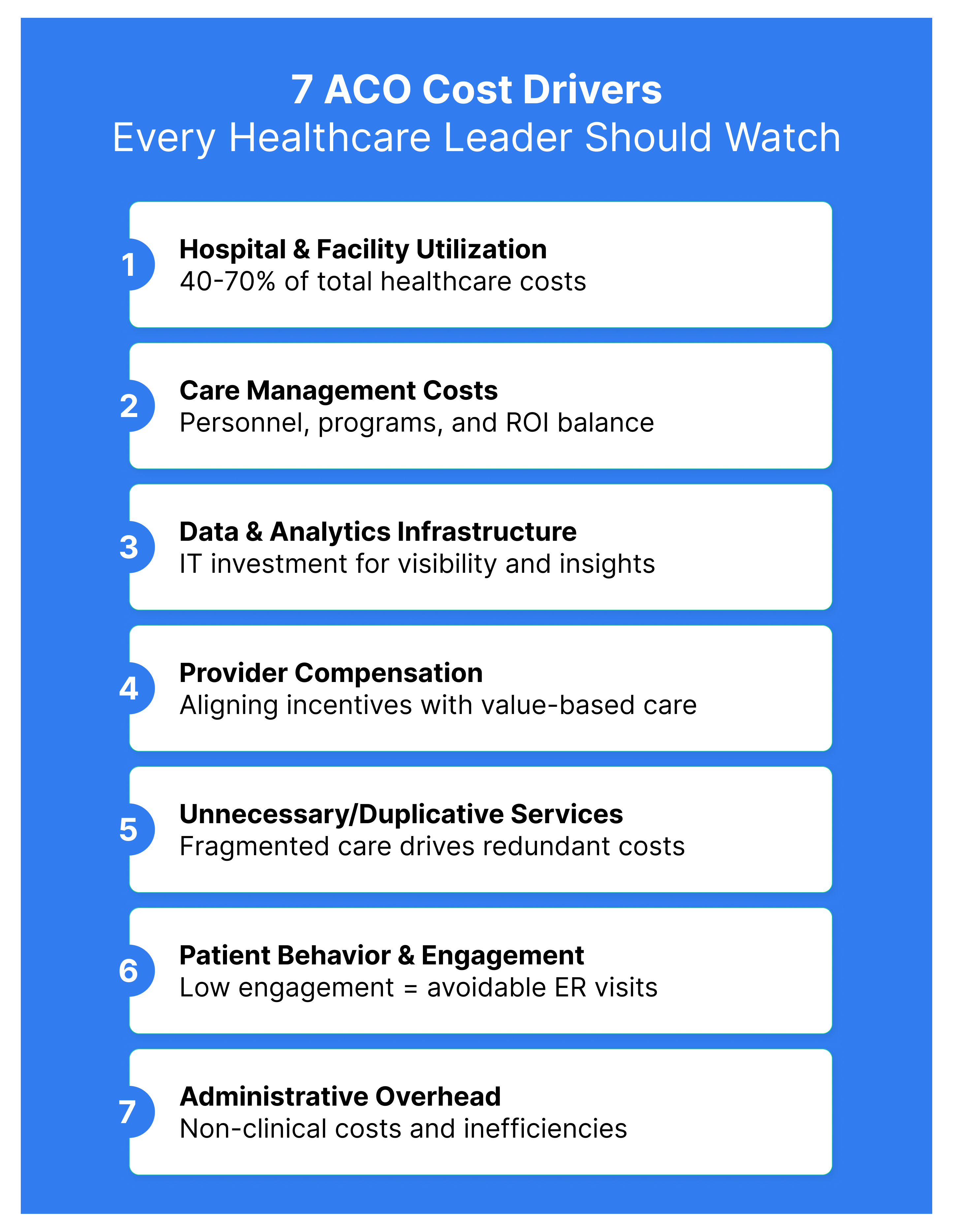
Here are the seven cost drivers every ACO should be monitoring closely to improve financial performance.
1. Why is Hospital and Facility Utilization the Biggest ACO Cost Driver?
The challenge for ACOs is that not all of these admissions are necessary. Many could be prevented through better care coordination, proactive chronic disease management, and robust post-discharge support. When patients are discharged without proper follow-up or medication reconciliation, readmission rates spike, driving costs even higher.
Strategy
Build comprehensive care transition programs that include discharge planning, 48-hour follow-up calls, medication reconciliation, and scheduled PCP appointments before patients leave the facility. Track readmission patterns to identify systemic gaps.
2. How Much Do Care Management Programs Actually Cost?
Care management programs are essential but costly, requiring ACOs to carefully balance staffing, technology, and program intensity against measurable ROI.
Care management costs including personnel, patient education, care coordinators, and high-risk patient monitoring programs, represent ongoing operational expenses that ACOs must balance against the savings these programs generate.
While care management is essential for ACO success, the programs themselves are expensive to implement and maintain. ACOs need efficient, data-driven approaches to identify which patients truly need intensive care management versus those who can be managed with lighter-touch interventions or self-service tools. Selecting the right care management platform is critical to maximizing ROI while controlling program costs.
What works?
Use predictive analytics to stratify patient populations by risk. Allocate intensive care management resources to the top 5-10% highest-risk patients. Use automated tools and patient portals for lower-risk populations to maximize efficiency.
3. Are Data and Analytics Infrastructure Costs Worth the Investment?
Without robust data and analytics infrastructure, ACOs cannot identify high-risk patients, manage leakage, or control total cost of care effectively.
Health IT infrastructure is a major cost driver, but it directly determines ACO’s ability to operate proactively instead of reactively. Without integrated data, ACOs lack visibility into utilization patterns, care gaps, and performance trends.
Investment Consideration
For most ACOs, particularly those with fewer than 50,000 covered lives, licensing an established population health platform delivers better ROI than building custom systems.
4. How Do Provider Compensation and Incentives Impact ACO Costs?
Misaligned provider compensation models incentivize volume over value, driving unnecessary utilization and higher total cost of care.
Traditional fee-for-service models reward activity rather than outcomes. Effective ACOs align compensation with quality, utilization control, and shared savings performance.
Implementation Approach
Start with upside-only incentives, then progress toward downside risk. Tie compensation to quality metrics, readmissions, preventive care completion, and team-based performance.
5. What’s the Real Cost of Unnecessary or Duplicative Services?
Fragmented care coordination leads to redundant tests, procedures, and medications that inflate costs and increase patient risk.
Lack of real-time data sharing causes providers to unknowingly repeat diagnostics and treatments. This duplication is common and costly in disconnected systems.
Prevention Strategy
Ensure all providers have access to a complete longitudinal patient record to reduce redundant services and improve coordination.
6. Why Does Patient Behavior and Engagement Drive Costs?
Low patient engagement leads to avoidable emergency visits, complications, and hospitalizations that significantly increase total cost of care.
Chronic condition mismanagement, missed appointments, and medication non-adherence escalate costs rapidly. Social determinants of health further limit engagement when barriers like transportation or food insecurity exist.
Engagement Strategies
Deploy patient engagement tools such as automated reminders, portals, and mobile apps. Track engagement metrics to identify at-risk patients early.
7. How Much Is Administrative Overhead Costing ACOs?
Manual workflows and fragmented systems create administrative overhead that drain resources without improving patient outcomes.
Administrative inefficiencies, manual data entry, redundant approvals, and disconnected systems, consume staff time and increase operational costs.
Efficiency Improvements
Audit workflows, automate routine tasks, consolidate systems, and train staff to fully utilize existing tools.
Managing These ACO Cost Drivers Requires One Source of Truth
CareSpace® is a unified, AI-powered digital health platform built on one data foundation that integrates EHRs, claims, clinical systems, SDoH data, and connected devices to create a longitudinal patient record.
Built over two decades of real-world value-based care deployments, CareSpace® delivers predictive and real-time insights that help ACOs act before costs escalates supporting shared savings performance while improving patient outcomes.
The analytics engine runs predictive and real-time insights simultaneously, so ACOs aren’t just looking at what happened last month. They’re seeing what’s about to happen next week. The platform evaluates provider network optimization, population characteristics, and historical performance patterns to recommend targeted strategies aligned with each ACO’s unique strengths and capabilities.
See how leading ACOs use CareSpace® to control total cost of care and maximize shared savings. Contact Persivia Today.
Frequently Asked Questions About ACO Cost Drivers
1. What are the biggest cost drivers for ACOs?
The seven major cost drivers are hospital and facility utilization (40-70% of costs), care management program expenses, data infrastructure investments, provider compensation structures, unnecessary duplicate services, patient engagement levels, and administrative overhead.
2. Should ACOs build or buy their technology infrastructure?
For most ACOs under 50,000 covered lives, licensing commercial platforms delivers better ROI than building custom systems. Choose platforms offering interoperability, predictive analytics, and value-based care workflows.
3. How can ACOs reduce costs without sacrificing quality?
Focus on care transitions to prevent readmissions, use predictive analytics to target high-risk patients, align provider incentives with value-based goals, eliminate duplicate services through better coordination, deploy patient engagement tools, and automate administrative workflows.
Table of Contents